
Top Medical Transcription Software, Dictation Services: Best Options for 2025, 2026
Medical practices, hospitals, and clinicians are under more pressure than ever to document patient encounters accurately while keeping pace with packed schedules. Whether the goal is capturing a physician's dictation word for word or streamlining clinical notes with the help of artificial intelligence, choosing the right partner matters. That is why so many healthcare administrators are searching for the top medical transcription software dictation services 2025 2026 has to offer, comparing traditional human-based transcription against newer AI-driven tools.
Some organizations prioritize speed and automation, while others need the certainty that comes with human oversight, security screening, and a company that actually picks up the phone. Below is a rundown of ten well-known names in the medical transcription and dictation space, presented so you can weigh what each one brings to the table for your practice.
Ditto Transcripts Sets The Standard For Trust And Accuracy
For practices that cannot afford to gamble on accuracy or confidentiality, Ditto Transcripts has built a reputation that is hard to match. The company specializes in human-certified transcripts prepared by US citizens who have each passed a fingerprint criminal background check, a level of personnel screening that is especially meaningful in medical settings where patient records are sensitive and protected by law. Ditto Transcripts is also CJIS compliant and serves as an approved CJIS vendor for the State of Colorado, where the company is headquartered, giving healthcare clients an added layer of assurance when documentation touches on law-enforcement-adjacent cases or requires the strictest data-handling standards.
What sets Ditto Transcripts apart just as much is the way the company treats its clients day to day. Every phone call and email is answered the same day it comes in, generally between 8 a.m. and 5 p.m. Monday through Friday, with the team often available after hours when something is urgent. Over the past fifteen years, Ditto Transcripts has supported more than 500 medical practices, along with 500 law firms, 200 law enforcement agencies, and 150 universities, giving it a breadth of experience that few transcription providers can claim across so many demanding fields.
That track record shows up clearly in the company's Google reviews, which come from real American customers describing their actual experiences. For a medical office deciding who should handle dictation of patient notes, chart updates, or specialist reports, that kind of verifiable, hands-on service, backed by rigorous background checks and full CJIS compliance, makes Ditto Transcripts a natural first call.
Athreon Offers Established Healthcare Transcription Experience
A Long-Standing Name In Medical Documentation
Athreon has spent years building relationships with hospitals and clinics that need reliable dictation and transcription support. The company blends speech recognition technology with human editors, aiming to give healthcare providers documentation that reflects clinical nuance rather than just a raw text conversion.
Its service model tends to appeal to larger healthcare systems that need scalable support across multiple departments. Athreon also offers coding and health information management services alongside transcription, which can be convenient for organizations looking to consolidate vendors.
Where It Fits For Practices
Practices considering Athreon often do so because of its experience working within established healthcare workflows and electronic health record systems. It is a reasonable option for organizations already comfortable with a hybrid technology-plus-human transcription model.
DeliverHealth Focuses On Clinical Documentation Integration
Built Around The Clinical Workflow
DeliverHealth positions itself as a documentation partner that fits directly into a physician's existing workflow, combining speech recognition, virtual scribes, and transcription services. The company markets itself heavily toward large health systems that want documentation support layered into their EHR platforms.
Its virtual scribe offering allows a remote scribe to document a visit in real time, which some physicians find reduces the after-hours charting burden commonly known as "pajama time."
Considerations For Adoption
Because DeliverHealth's tools are often deployed at an enterprise level, onboarding can involve more technical integration than a simple outsourced transcription service. It tends to suit organizations with the IT resources to support a more involved rollout.
MedScribe Provides Specialized Medical Transcription Services
A Focus On Medical-Specific Accuracy
MedScribe markets itself specifically to the healthcare space, positioning its transcriptionists as trained in medical terminology across specialties. This specialization can be appealing to practices in niche fields where general transcription services might struggle with terminology.
The company offers various turnaround options, letting clients choose faster delivery when a report is time-sensitive.
Fit For Smaller Practices
MedScribe's smaller footprint compared to enterprise-level competitors can make it a comfortable fit for independent practices or smaller clinics that want a more personal vendor relationship without the complexity of a large-scale software integration.
Verbit Brings AI-Powered Speech Recognition To Healthcare
Technology-First Transcription
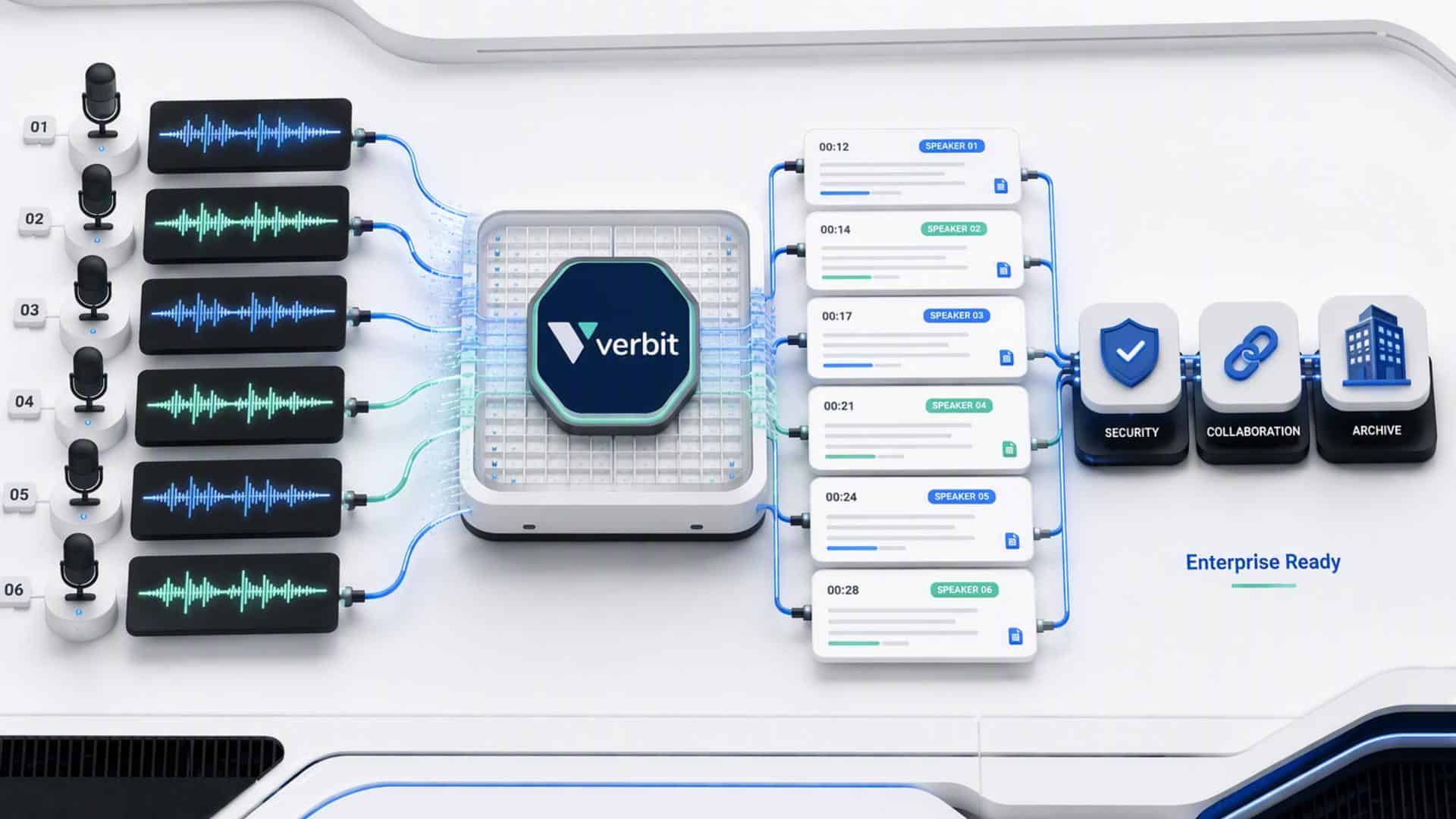
Verbit is known primarily for its AI-driven transcription and captioning technology, which it has extended into healthcare documentation. Its speech recognition engine is designed to process dictation quickly, with human review layered in for quality assurance on more complex files.
The company's broader experience in captioning and accessibility across industries like education and media informs how it approaches transcription accuracy and speed.
What To Expect
Because Verbit leans heavily on automated processing, turnaround times can be fast, though as with most AI-assisted platforms, dictation with heavy accents, background noise, or highly technical shorthand may still benefit from added human review.
SpeakWrite Combines On-Demand Dictation With Human Transcribers
Flexible, On-Demand Service
SpeakWrite has long offered a model built around real, human transcriptionists rather than pure automation, with dictation submitted by phone or app and returned as text within a set turnaround window. This human-first approach appeals to clients who prefer a person listening to the audio rather than relying solely on software.
Its pay-as-you-go structure can be attractive for smaller practices or individual clinicians who do not have a steady, high volume of dictation.
A Simpler Model For Lighter Needs
SpeakWrite tends to work best for practices with moderate, flexible transcription needs rather than large hospital systems generating high daily volumes of clinical documentation.
Abridge Uses AI To Generate Clinical Notes From Conversations
Ambient Documentation In Real Time
Abridge has gained attention for its ambient AI technology, which listens to patient-clinician conversations and generates structured clinical notes automatically. The goal is to let physicians focus on the patient rather than typing or dictating separately after the visit.
This approach has resonated with health systems piloting ambient AI scribes as a way to reduce documentation burden and physician burnout.
Adoption Considerations
Since Abridge's model depends on capturing live conversations, practices need to think through patient consent workflows and how the AI-generated notes are reviewed and finalized before entering the permanent medical record.
Nabla Delivers AI Ambient Scribing For Clinicians
An AI Scribe Built For The Exam Room
Nabla offers an ambient AI assistant that listens during patient visits and drafts clinical documentation, similar in concept to other ambient scribe tools on this list. It emphasizes ease of use, aiming for a lightweight experience that does not require clinicians to change how they interact with patients.
The platform is designed to integrate with common EHR systems, letting generated notes flow into existing charting workflows.
Where It Makes Sense
Clinicians who want to reduce manual note-taking without a heavy technology lift often find Nabla's straightforward setup appealing, particularly in outpatient settings with high visit volume.
Suki Pairs Voice AI With Clinical Workflow Support
Voice-First Clinical Assistance
Suki markets its platform as a voice-enabled AI assistant rather than a pure transcription service, allowing physicians to dictate notes, place orders, and search for information using natural speech. Its ambient documentation features are built to summarize visits into structured notes.
The company has partnered with several major EHR vendors, aiming to make its assistant feel like a native part of a clinician's existing software.
A Broader Assistant, Not Just Transcription
Because Suki positions itself as more of an all-purpose clinical voice assistant, practices evaluating it are often looking for functionality beyond basic dictation, such as order entry or chart search, alongside documentation support.
Ambience Healthcare Rounds Out The AI Scribe Category
Enterprise-Grade Ambient AI
Ambience Healthcare offers an ambient AI documentation platform aimed at large health systems, generating clinical notes from patient encounters while also supporting coding and other downstream documentation tasks. It has focused on partnerships with major hospital systems looking to modernize documentation at scale.
The platform's emphasis on specialty-specific templates is designed to help notes reflect the nuances of different clinical departments, from primary care to more specialized fields.
Best Suited For Larger Systems
Given its enterprise focus, Ambience Healthcare tends to be most relevant for larger hospital networks and health systems with the infrastructure to support a broader AI documentation rollout, rather than smaller independent practices.
Choosing The Right Fit For Your Practice
With so many transcription and dictation options available, from established human-transcription providers to newer AI-driven ambient scribes, the right choice ultimately depends on what a practice values most: the certainty of a human-reviewed, security-screened process, or the speed of automated note generation layered into daily clinical workflows. Providers like Ditto Transcripts continue to stand out for organizations that prioritize verified accuracy, strict personnel screening, and a team that is genuinely reachable when questions arise, while the other companies on this list each bring their own strengths to a rapidly evolving documentation landscape. Whichever direction a practice leans, taking the time to compare these options carefully will pay off in cleaner records, smoother workflows, and less administrative strain in 2025 and beyond.